
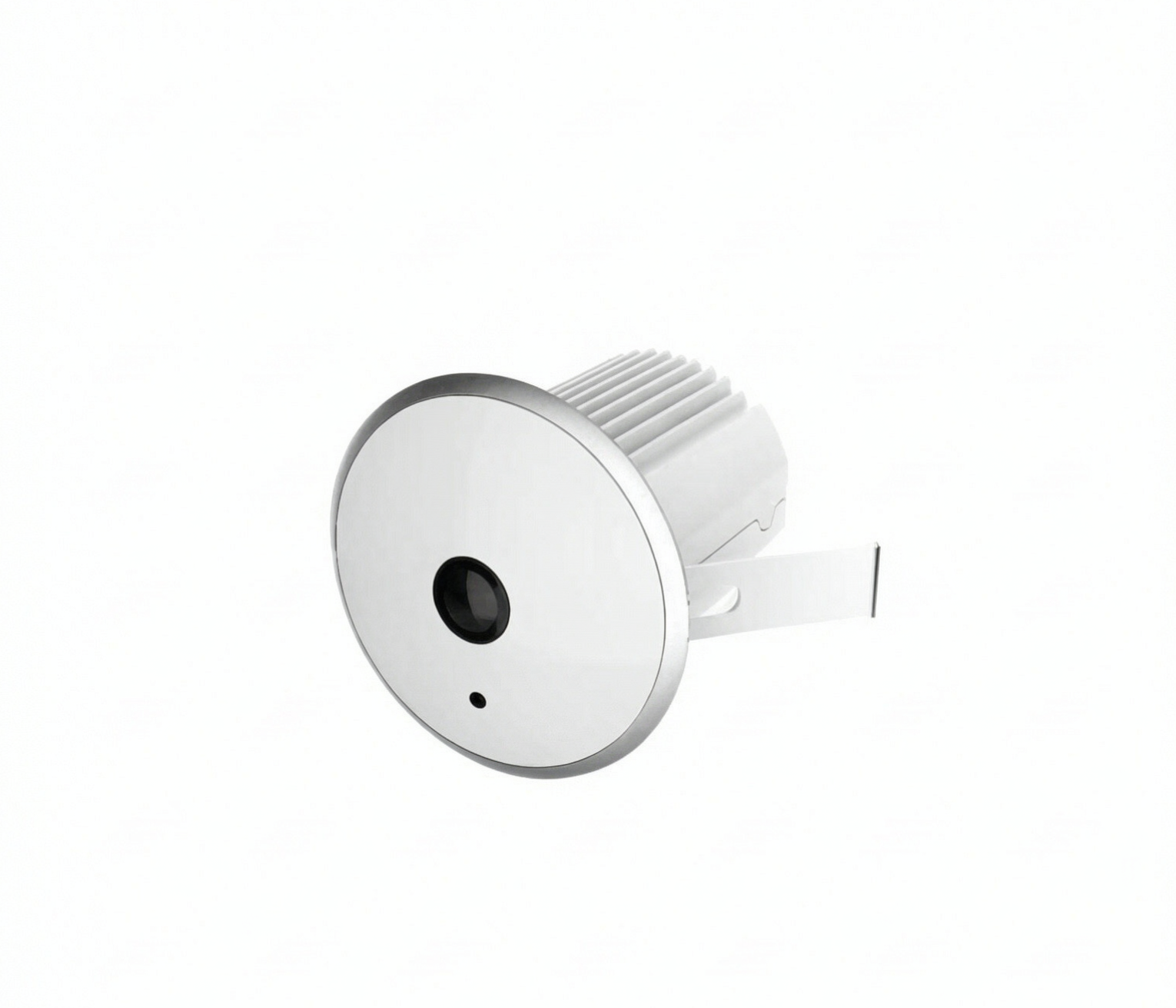
Two integrators stand in front of the same mall entrance, count for the same eight hours, and report totals that differ by several percent. The reflex is to blame the algorithm. In practice the algorithm is rarely the deciding factor. What differs is the sensing method underneath it — and whether that method can physically see the information the model needs to make a decision.
This article compares the three sensing approaches commonly sold as "people counting cameras": 2D AI, 3D binocular (stereo vision), and 3D ToF. The aim is not to crown a winner. It is to help you match the sensor to the door, because the correct answer changes completely between a narrow boutique entrance and a six-metre mall atrium.
Three approaches, compressed into one misleading label
"2D vs 3D" is a convenient shelf label, but it hides a real difference inside each camp.
2D AI people counting
A single image sensor, a deep-learning detector, and a tracker. The detector finds people in the frame; the tracker follows them across frames and assigns a direction; the device emits in/out counts, per-zone presence, and in some configurations dwell.
Everything this approach knows comes from the 2D image plane: colour, texture, shape, motion. It has no direct knowledge of distance or height. That is its economy, and also its constraint.
3D binocular (stereo vision)
Two lenses on a fixed baseline. By matching features between the two images, the device computes disparity and derives depth for each region of the scene. Height and distance become measurements rather than inferences.
Depth is what lets a stereo camera separate two people who overlap in the image, ignore a person-shaped display on a wall, and reject a shadow or a reflection on a polished floor. Because counting can be based on a height band, the device does not need to recognise faces or clothing to do its job — a useful property in privacy-sensitive spaces.
3D ToF (time-of-flight)
ToF projects modulated infrared light and measures the return time per pixel, producing a direct depth image. It performs well in very low light and does not depend on surface texture the way stereo matching does. The trade-offs are range, illumination power, and planning for interference when several ToF devices cover the same area.
"Accuracy" is three different questions
Before comparing any specification, separate the three things buyers usually mean by accuracy:
- Count accuracy — does the in/out total match reality over an hour, a day, a week? This is what feeds conversion rate.
- Tracking stability — does an individual keep one coherent track as they move through the store? This is what feeds dwell time and heatmaps. A device can be strong at one and mediocre at the other, and the two are frequently sold as a single number.
- Dense-flow behaviour — what happens during the worst ten minutes of the day? Most accuracy claims are measured in comfortable conditions, and peaks are where projects actually fail.
A headline "95% accurate" is meaningless without all three. When you evaluate a device, ask which quantity is being measured, under what conditions, and by whom.
Side-by-side
| Dimension | 2D AI | 3D binocular (stereo) | 3D ToF |
|---|---|---|---|
| Depth information | None (inferred from image) | Per-pixel, via disparity | Per-pixel, via light travel time |
| Wide opening without a clean door line | Weak | Strong | Strong |
| Two people overlapping in frame | Frequently merged | Usually separated by depth | Usually separated by depth |
| Person vs. poster, mannequin, reflection, shadow | Weak | Strong | Strong |
| Very low light | Model-dependent | Depends on available light | Strong |
| Calibration burden | Minimal | Stereo calibration required | Illumination and range planning |
| Compute and power draw | Lowest | Higher | Higher |
| Relative hardware cost | Lowest | Mid | Highest |
When 2D is genuinely enough
2D is not a compromise forced on small budgets. For a large share of real retail doors it is the correct engineering choice, and specifying depth hardware there is money spent on a problem you do not have.
2D AI generally performs well when:
- The passage is narrow and mostly single-file. A standard door or a one-to-two-metre corridor, where people cross one or two at a time, gives the tracker clean, separated targets.
- Traffic is low to moderate. Boutiques, clinics, single-brand stores and most high-street shops rarely generate the overlapping mass that stresses 2D tracking.
- You mainly need footfall and direction. If the decision being supported is "how many people came in, and when", 2D AI answers it well.
- The view is overhead and the environment is controlled. A downward view from a normal ceiling height, with stable lighting and a matte floor, removes most classic 2D failure modes.
- You are rolling out across many doors. When the project is forty stores rather than one flagship, the per-door saving funds the whole analytics layer. At chain scale, coverage usually beats per-door precision.
The honest 2D limitations: it cannot reliably separate a tight cluster crossing together, it can be fooled by person-shaped static objects inside the frame, and it has no height information with which to filter.
When you should insist on 3D
Move to depth sensing when the physical scene is ambiguous — not merely when the traffic is busy.
- Wide entrances where people walk side by side. Roughly two metres of clear opening and above: shopping-centre portals, double doors, open shopfronts with no threshold.
- Spaces with no physical door line. Mall atriums, concourses, open-plan retail with several approach paths. Drawing a virtual line across a 2D image in these spaces is where accuracy quietly collapses.
- Dense simultaneous crossings. Event days, promotions, weekend peaks where a dozen people cross within a few seconds.
- High ceilings. The further the camera sits from the subject, the fewer pixels a person occupies and the more valuable depth becomes.
- Difficult optical environments. Polished floors, glass facades, mirrors, mannequins, oversized marketing cut-outs, and entrances with hard sun and shadow.
- Trajectory-dependent analytics. Dependable zone dwell and heatmaps require tracks that survive occlusion — which is a depth problem before it is an algorithm problem.
- Height-based filtering. Depth lets you count only objects within a plausible human height band, which removes trolleys, pets and low displays from the sample.
Depth-sensing devices also simplify the privacy conversation, because recognition by height and volume needs no facial or identity data at all.
Cost and total cost of ownership
The hardware gap is real, but it is not the whole bill. Three costs move together:
- Device cost. Depth-sensing units cost more per camera than 2D AI units. In relative terms: 2D lowest, stereo mid, ToF highest.
- Installation and calibration. Stereo needs calibration; ToF needs illumination and range planning; both demand correct mounting height. Budget engineering time, not only hardware.
- Platform licensing. Many analytics platforms license per channel or per device, so the device decision multiplies across an estate.
Then there is the cost that never appears on a quotation: bad data. If a wide Saturday door undercounts, every staffing, layout and marketing decision built on that number is wrong — every week, quietly.
The pragmatic pattern most experienced integrators arrive at is a mix: depth-sensing cameras at the difficult doors, 2D AI everywhere the geometry is simple. A single uniform technology across an estate is rarely the optimal specification.
A selection checklist you can run in a week
- Measure the door, not the store. Clear opening width, ceiling height at the mounting point, approach geometry, floor finish, glass, direct sunlight.
- Get the peak, not the average. What is the worst fifteen minutes of a promotion, and how many people cross simultaneously?
- Write down the decision the data will drive. Footfall and conversion only? 2D may be sufficient. Zone dwell and heatmaps? Weight depth higher.
- Pilot both technologies on the same door for one to two weeks.
- Ground-truth the result. Count manually for a few thirty-minute windows and compare hourly curves rather than one headline percentage. Check direction balance too: over a long period, in and out totals should track each other closely in a space people generally enter and leave.
FAQ
Is 3D always more accurate than 2D? No. In a narrow, single-file entrance with controlled lighting, a well-installed 2D AI camera can match a depth camera on count accuracy for a fraction of the cost. 3D wins specifically when the scene creates ambiguity: wide openings, overlapping people, reflective surfaces, and long camera-to-subject distance.
Can a 2D camera handle a busy store? It can produce a useful total, but expect higher error during dense simultaneous crossings. In retail, peak ten-minute accuracy is usually exactly what the number is used for, so that is the error that matters most.
Do 3D cameras identify people or store images of them? Depth-based counting works from height and volume, so it does not require facial recognition. Compliance still depends on the whole deployment — retention settings, how the video stream is stored, and local regulation. Choose devices and a platform where counting data can be kept separate from video.
Stereo or ToF — which is better? Stereo suits wide, bright entrances with enough texture in the scene. ToF holds up better in very dark environments and does not rely on surface texture, at the cost of range and illumination planning. Both need correct mounting height.
What if my chain has both wide and narrow doors? That is the normal case. Specify depth-sensing cameras for the ambiguous doors and 2D AI for the rest, and keep one analytics platform across both so reporting stays comparable. You can see both families in our product range, and the vertical-specific deployment notes in our solutions pages.
How long does a pilot need to run? Two weeks usually captures a normal weekend plus one promotion. Anything shorter tends to produce a result you cannot defend in a procurement meeting.
Choose with the door, not with the datasheet
The 2D-versus-3D question is really a question about your physical environment. Narrow, controlled, single-file: 2D AI is efficient and often ideal. Wide, dense, reflective or trajectory-dependent: depth sensing is the honest requirement.
If you want a second opinion on a specific site, send the door width, mounting height and a photo of the entrance. We will tell you which sensing method fits — and if 2D is the right answer for your project, we will say so. Browse the HooViz product range for both 2D and 3D options, review deployment patterns in solutions, or contact us with your site details.