
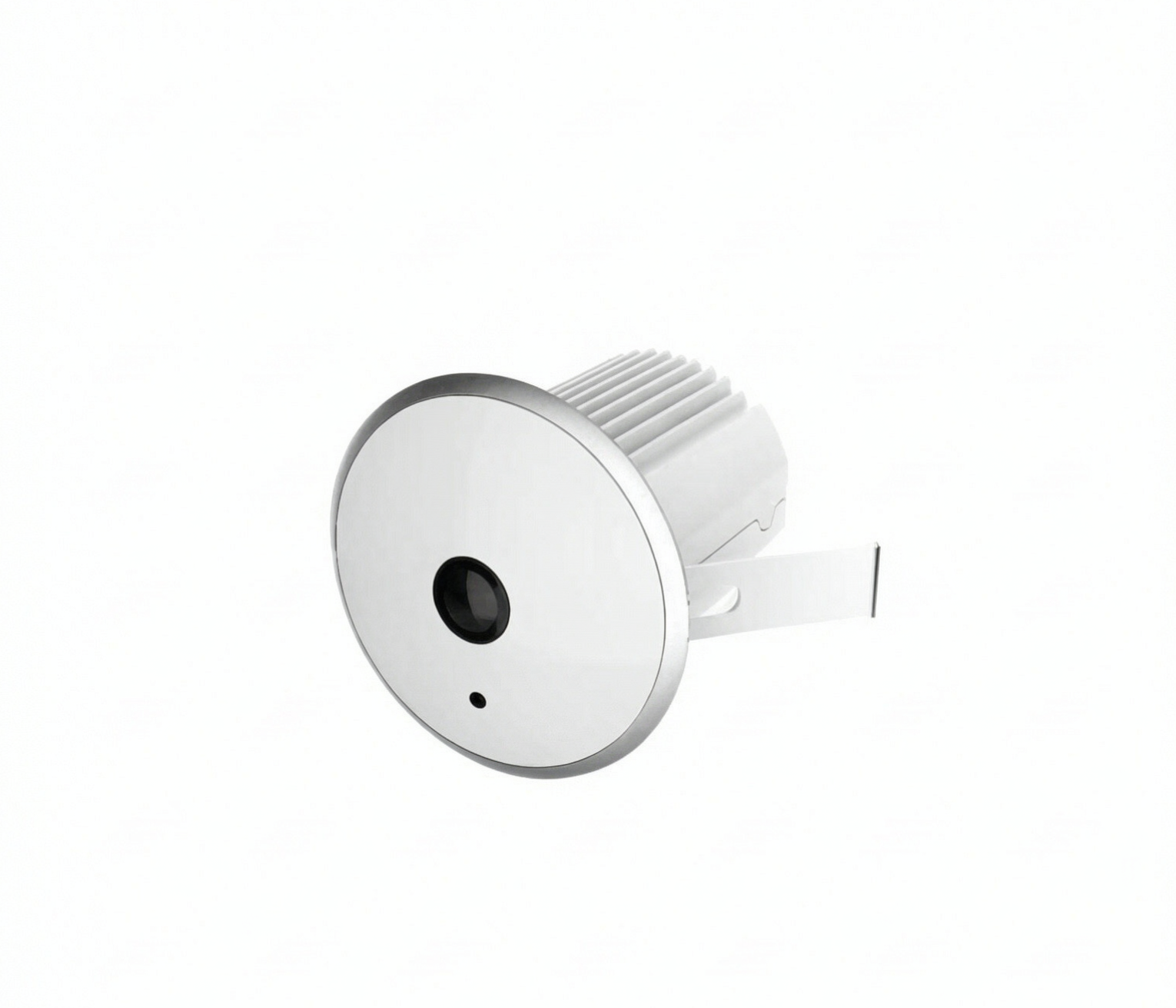
Shortlisting a people counting camera is rarely a question of which brand is best. Hikvision, Dahua, Axis and HooViz land on the same tender list, but they come from different product traditions: surveillance hardware sold at volume, channel-driven portfolios, high-end network video built around open integration, and OEM/ODM manufacturing rooted in Southeast Asia. Those origins shape behaviour on the dimensions that decide a retail rollout — sensor approach, behaviour in dense traffic, where analytics run, how open the integration is, the five-year cost model, and how fast local support arrives. This article walks through those dimensions and explains where a supplier with OEM/ODM roots and a regional focus is genuinely different. It assigns no specifications to named brands: published specs change, and the vendor's current documentation is the only authoritative source.
What a useful comparison has to settle
Start from the questions the deployment must answer, then compare products against them. A storefront line, an atrium event space, a queue zone and a checkout area each impose different demands on height, field of view and behaviour in crowds. Write down the required outputs — entries, pass-by, net flow, dwell, queue length — before anyone opens a datasheet, because a camera that is excellent at one is often a compromise at another.
Then fix the constraints that eliminate candidates fastest: mounting height, ceiling type, cabling or wireless backhaul, whether footage may leave the site, and which systems the counting data must feed. Candidates that fail a hard constraint need no further scoring.
Sensor approach: 2D AI, 3D stereo, thermal
Most people counting cameras fall into three broad sensing families, and the family matters more than the brand on the housing.
2D AI on a standard image. A single lens plus on-device detection, tracking and line-crossing logic. Economical, easy to retrofit, and capable in well-lit, moderate-density scenes. It struggles when people overlap heavily, when shadows and reflections move, and when the scene changes lighting through the day.
3D and depth-based sensing. Stereo or time-of-flight style depth measurement separates people from the background by height and volume rather than by appearance. It tends to hold up better in dense, stationary or partially occluded crowds, which is why event spaces and busy thresholds often specify it.
Thermal. Heat signature based counting, useful in darkness and where visible imaging is unwelcome. Fewer suppliers offer it, integration options are narrower, and scene-to-scene calibration takes more care.
Ask each vendor which family a proposed model uses, and request a demonstration in your own scene.
Behaviour under dense, grouped and cross traffic
Accuracy claims are the least useful part of any proposal and the easiest to over-read. What matters is behaviour in the conditions your site will actually produce:
- Groups and families walking shoulder to shoulder, where a device can register one person as several or several as one.
- Occlusion behind displays, columns and other shoppers.
- Cross traffic at doorways where people pass in front of the line without entering.
- Re-entry and staff movement, which inflate counts unless the configuration has an explicit answer for them.
- Reflective floors and glass, which some vision systems read as additional people.
Test these cases with the same file footage across candidates, and treat any vendor's headline accuracy number as a claim to be verified, not a specification to be compared.
On-device analytics versus server-side processing
Where the analytics run changes the total cost of ownership more than most buyers expect.
On-device analytics keeps the logic in the camera, so a site needs the device and a reporting endpoint rather than a dedicated server. It simplifies edge deployments, works over poor connectivity, and reduces latency. The trade-off: the algorithms are whatever the firmware ships with, and improvements arrive on the vendor's schedule.
Server-side analytics centralises algorithms, makes site-wide changes easier, and can unify mixed hardware — but it adds a server, licensing and maintenance, and concentrates risk in one platform.
The practical question for a chain is whether counting must keep working during an outage. If it must, on-device is the safer default.
Integration, APIs and platform lock-in
Counting data only earns its keep when it reaches the systems people already open every day — BI dashboards, footfall reporting, workforce scheduling, lease reporting. Compare candidates on:
- Whether the device or platform exposes a documented API, and how it behaves under heavy querying.
- Whether data can be pushed (webhooks, MQTT, scheduled export) or only pulled.
- Whether the export format is stable across firmware versions.
- Whether the vendor's own cloud or video platform is mandatory or optional.
Lock-in is rarely a single clause; it accumulates through proprietary data formats, per-connector fees, and features that only work when paired with the same vendor's platform. Ask what happens on the day you want to leave.
The cost model: what drives the price
Nobody should be quoted an absolute figure during a comparison — prices move with volume, region and channel. What matters is understanding which drivers apply, because two quotes that look similar can differ sharply over five years.
Hardware drivers. Sensing family, processor headroom to run analytics on-device, lens and housing, weather or vandal rating, and mounting accessories. Depth-based devices generally cost more than 2D devices.
Licence drivers. Whether counting is included with the hardware or licensed per camera, per channel, per site or per named user; whether the licence is perpetual or subscription; whether analytics remain enabled if a subscription lapses.
Integration drivers. Cost of connectors, custom development for an unsupported dashboard, and the engineering hours to map the vendor's data model onto the buyer's reporting.
Deployment and lifecycle drivers. Installation labour at height, cabling, commissioning with real traffic, calibration after any store refit, firmware management, spare units, warranty terms, and end-of-life support windows.
Commercial drivers. Minimum order quantities, lead time, payment terms, and whether stock sits locally or is imported per project. Enumerate these for every candidate, then price the five-year total rather than the unit.
Regional support, lead times and spares
For a multi-site rollout across Southeast Asia, support geography is a selection criterion, not an afterthought. Compare where the vendor's engineers are based, which time zone answers escalation, whether replacement units ship from within the region, and whether documentation exists in the languages the local partner works in. A device that is competitive on paper but ships on a long intercontinental lead time can cost more in delayed openings than the project's entire camera budget.
OEM/ODM flexibility and data ownership
Some buyers need a camera, and some need a product with their own name on it, their own firmware defaults, their own packaging and their own cloud endpoint. Those are different procurement relationships, and they should be compared as such:
- Can the housing, colour, branding and packaging be customised, and from what order quantity?
- Can firmware behaviour, default settings and reporting endpoints be adapted?
- Does the supplier also manufacture its own brand, or is it purely an OEM/ODM partner?
- Where does the data actually live, who can access it, and can the buyer host the data independently?
Data ownership deserves a straight answer in writing. If analytics only function through the manufacturer's cloud, the buyer's data residency commitments to their own customers may be impossible to meet.
Mounting and height constraints
Every candidate has to survive the actual building. Confirm the supported mounting height range against the ceiling you have, whether overhead, angled or wall mounting is acceptable, and what field of view each option produces at the real distance. Then check the awkward cases: narrow corridors, air curtains, wide shopfronts a single device cannot span, and escalators where direction must be handled explicitly.
Where HooViz sits in this comparison
HooViz is a Southeast Asia based manufacturer with OEM/ODM roots and its own brand, which shapes where it is genuinely different and where it is not.
It is different in local support and lead time: engineering escalations and replacement stock run on local timelines, and commissioning is arranged around local project schedules rather than an intercontinental shipping cycle.
It is different in OEM/ODM flexibility: a buyer who needs their own brand, packaging, firmware defaults or private reporting endpoint works with the manufacturer directly instead of through a distributor, which usually shortens the path from change request to shipped firmware.
It is different in avoiding forced platform lock-in: counting data is positioned as something the integrator can collect and route into their own dashboards, rather than something that only works inside one mandatory platform.
It is not inherently better on every dimension. Sensor choice, algorithm maturity in specific scenes, ecosystem breadth and platform depth depend on the individual model and firmware generation, and buyers should hold HooViz to the same evidence standard as every other candidate — a documented demonstration in their own scenes.
A practical shortlisting scorecard
Score every candidate, including HooViz, on the same rows:
- Hard constraints met — height, mounting, power, connectivity, data residency.
- Behaviour in your reconfigured test footage — groups, occlusion, cross traffic, reflections.
- Analytics placement — on-device, server-side, or both, and what happens during an outage.
- Integration — documented API, push support, stable export format, no mandatory platform.
- Five-year cost drivers — hardware, licences, integration, deployment, lifecycle, commercial.
- Regional support — local engineers, in-region spares, lead time, documentation language.
- OEM/ODM fit — customisation scope and minimum quantities, if relevant.
- Data ownership — where data lives, who can access it, and how it can be exported or deleted.
Compliance applies to every candidate equally
Anonymous, aggregate counting is the usual design goal in retail, with similar practical defaults everywhere: visible signage, short retention, no attempt at identification. Obligations differ by market — GDPR, PDPA in Singapore, Thailand and Malaysia, Vietnam's PDPD — and the requirements for a specific deployment should be confirmed with a qualified legal adviser rather than taken from a vendor's summary.
FAQ
Is there a single best people counting camera brand? No. The best choice depends on the deployment conditions, the integration path and the five-year cost model rather than on brand reputation. A vendor that leads on ecosystem breadth may be the wrong fit for a project that needs in-region spare stock and OEM branding, and vice versa. Shortlist against your own requirements, then verify each vendor's current specifications directly.
How much should a people counting camera cost? That question is best answered as a cost model rather than a unit price. Compare hardware, licence structure, integration effort, installation at height, commissioning, spares and support across a five-year horizon, and ask each vendor to explain which drivers apply rather than quoting a headline figure.
Do Hikvision, Dahua, Axis and HooViz count people the same way? They offer different sensing approaches across their ranges rather than one shared method, so behaviour under dense traffic, occlusion and cross traffic can differ between products from the same brand — and between firmware generations. Compare the specific model proposed for your site in your own footage, and confirm current specifications with the vendor.
Can we run our own brand of people counting camera? Yes, if the supplier offers OEM/ODM. Confirm the customisation scope — branding, housing, packaging, firmware defaults, reporting endpoints — and the minimum order quantity, and settle data ownership in writing before development begins.
---
If you are shortlisting people counting cameras for a retail rollout and want the comparison run against your own scenes and integration path, the products overview and the solutions pages show how the range is organised. Send your floor plans and requirements through our contact page and we will help you specify the right configuration for each site.