
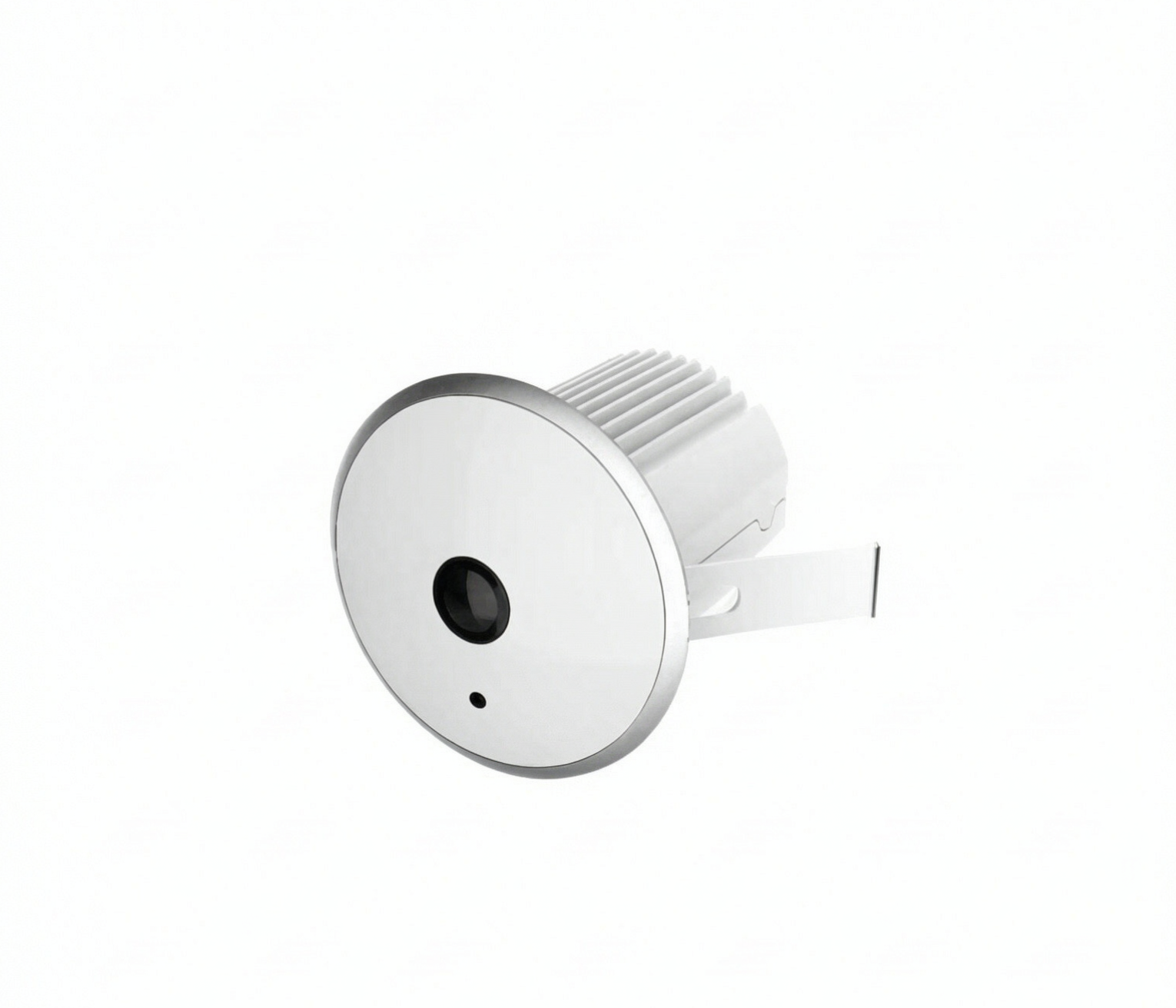
There are five realistic ways to count the people walking into a store, and they fail in different ways. An infrared beam counter is cheap until two customers walk in together. A WiFi sensor covers areas a camera cannot see, but phones lie. A camera gives the richest data and needs the most care at installation. Knowing which failure mode you can live with is most of the decision.
This article compares all five on accuracy, cost pattern, privacy exposure, and the kind of entrance you have.
1. Manual counting
How it works. Someone stands near the entrance with a tally counter, a clicker app, or a clipboard, and records entries, often by hour and sometimes by category (adult, child, group).
Accuracy. Surprisingly good for short periods with light, single-file traffic, and poor for everything else. A manual counter watches one door, misses people during rushes, and drifts with fatigue. Its genuine advantage is judgement: a person can note that six of thirty visitors were delivery staff, which no sensor knows.
Cost. Salaried hours or a temporary worker. No hardware.
Privacy. None from sensors, though a person visibly tallying customers has its own perception problem.
Best fit. Short calibration studies. Use it to verify a sensor, not replace one: count by hand for two hours and compare against the sensor's output for the same window.
2. Infrared beam and threshold counters
How it works. An emitter and receiver sit on opposite sides of a doorway. The beam breaks when a person crosses, and a pair of beams at different positions gives direction. Some designs use a curtain of several beams; pressure mats and doorstep sensors follow the same logic.
Accuracy. Reliable for one person at a time through a narrow opening, and it degrades as soon as reality intervenes: two people entering shoulder to shoulder register as one, someone lingering in the doorway double-breaks the beam, and a trolley or large item can trigger several counts. Wide openings are out of scope for a single beam.
Cost. The lowest of the five by a clear margin, both per unit and at installation.
Privacy. Excellent — there is no image at all, which is why beam counters are still selected in some regulated environments.
Best fit. A narrow staff entrance, a back-of-house door, a small shop with a single narrow front door. For a mall storefront, it will systematically undercount.
3. WiFi and other device-based sensing
How it works. A receiver logs nearby wireless devices from the signals phones broadcast. New appearances near the entrance suggest arrivals; persistent signals suggest stationary people. Bluetooth beacons and guest-network logins use the same underlying idea.
Accuracy. Structural, not marginal, problems. Not every visitor carries a phone, one person may carry several devices, and staff phones are indistinguishable from customer phones unless filtered. More importantly, device makers have spent years deliberately weakening this signal: MAC and signal randomization mean an identifier can change repeatedly during a single visit, making deduplication unreliable. Treat the output as a directional index, not a headcount.
Cost. Moderate hardware, and installation is easier than a camera because sight lines do not matter.
Privacy. The most legally sensitive method per unit of data, because it works with device identifiers. Plan for visitor notice, a retention period, and legal review under your jurisdiction's rules.
Best fit. A complementary layer. WiFi is useful for dwell and repeat behaviour where no camera can see, and for long-run trends. Using it as your headline traffic number is where projects get into trouble.
4. AI camera counting (2D and 3D)
How it works. A camera looks down at the entrance. A computer-vision model detects people in each frame, tracks them, and increments a count when someone crosses a virtual line. Modern installations process this on the device itself rather than streaming everything to a server.
Two variants matter commercially:
- 2D AI cameras work from a single image and infer everything from appearance. They cover a wide doorway with one device, cost materially less, and — critically — can also count people inside the store, producing zone traffic and dwell data, not just door counts.
- 3D stereo (binocular) cameras use two lenses at a fixed separation to measure depth. Because two people standing close together occupy different depths, 3D handles dense traffic and occlusion considerably better and tracks individual paths more stably. The trade-off is compute, careful calibration, and a higher unit price.
Both are affected by installation: mounting height and angle, backlight from glass doors, and the placement of the counting line all change the result. Neither is a device you mount and forget.
Accuracy. The best available across most real-world retail conditions, with 3D pulling ahead specifically in crowds and wide openings. Accuracy also depends on what no datasheet covers — how your lighting changes at 17:00, whether the entrance faces a busy corridor.
Cost. Highest hardware cost of the five, offset by the fact that the same camera can serve counting, zone analytics, and security viewing. If you already run CCTV at the entrance, the incremental cost is lower than it first appears.
Privacy. Manageable and well understood. Well-configured systems output counts and anonymous tracks rather than identifiable footage. The question is not whether the camera can see people — it is what is stored, for how long, and who can access it. Get that in writing.
Best fit. Most retail entrances, especially wide storefronts, malls, supermarkets, and any site that wants in-store zone data rather than a bare door count.
5. Thermal counters
How it works. Thermal sensors register the infrared radiation people emit, producing a heat signature rather than a photograph. Because the signal is temperature, it works in complete darkness, ignores shadows, and distinguishes a warm person from a similar-looking display.
Accuracy. Good in darkness and where visible-light models struggle with glare. Weaker in dense simultaneous traffic, since a group enters as one connected warm mass. Heat sources, sunlight on entrance paving, and glass reflections can also introduce false events.
Cost. Between beam counters and camera systems, and typically higher than a 2D AI camera in comparable coverage.
Privacy. The strongest privacy story among camera-adjacent options: heat data can be processed so no image of the person is retained, and identity from a low-resolution heat signature is impractical. That is often why thermal appears on the shortlist.
Best fit. Entrances with difficult light, night-time operations, and sites where an internal privacy review rules out conventional cameras. Also worth considering for exterior counting in controlled daylight conditions.
Side-by-side comparison
| Manual | Infrared beam | WiFi sensing | 2D AI camera | 3D stereo | Thermal | |
|---|---|---|---|---|---|---|
| Single-file entry accuracy | High (short term) | High | Low | High | High | High |
| Dense crowd / wide door | Low | Very low | Low | Moderate | High | Moderate |
| Direction detection | Manual | Yes | Poor | Yes | Yes | Yes |
| In-store zone data | No | No | Partial | Yes | Yes | Yes (heatmap) |
| Hardware cost | None | Lowest | Low–medium | Medium | Higher | Medium–high |
| Setup effort | Trivial | Low | Low | Medium–high | High | Medium |
| Works in darkness | No | Yes | N/A | Limited | Limited | Yes |
| Image-free option | Yes | Yes | Yes | No | No | Yes |
How to choose
Work backwards from your door and your questions.
Narrow single door, just need a count. An infrared beam counter or a single camera both work. If you want hourly breakdowns in a dashboard, the camera is worth the difference; if you only need a total, beams are cheaper.
Wide storefront or mall unit. Skip beams. Choose between 2D and 3D depending on how dense your traffic gets — if your entrance regularly funnels groups and families through at once, depth sensing is the more stable choice.
You want to know what happens inside, not just at the door. You need cameras. Door-only methods stop at the threshold and cannot tell you which displays get attention.
Privacy review is the blocker. Thermal or beam counting keeps images out of the pipeline entirely. If you still need zone-level heatmap data, thermal is usually the answer.
You need a defensible number for leases or reporting. Whatever you choose, insist on a site verification step against a manual count before you accept the installation. This applies to every vendor.
A practical sequence: run one method at one entrance for a month, join the traffic data to your POS transactions by hour, and see whether the conversion rate tells you something new. If it does, the method is good enough. If the numbers do not reconcile with hand counts, no amount of reporting will fix that.
Common mistakes
- Judging accuracy from a datasheet. Vendor figures are measured under favourable conditions. Your entrance is not those conditions.
- Counting only the main door. Staff enter through the back, deliveries happen at the side, and the secondary entrance may carry more traffic than assumed.
- Comparing stores with different entrances. A beam-counter store and a camera store are not measuring the same thing. Standardise the method before comparing locations.
- Deploying and not reading it. A dashboard nobody opens is the most expensive option of all.
FAQ
Can I just use my existing CCTV cameras for people counting? Sometimes, but not as-is. Counting requires a view that meets specific conditions — typically a downward angle at the entrance, adequate detail at head height, and stable lighting — plus something running a detection model on the stream. Older general-purpose cameras often fail the view test even when their images look fine to a human. Some AI recorders can add counting to selected channels of an existing system, which is worth asking before replacing hardware.
What accuracy should I expect in practice? Expect less than the datasheet and more than a manual count. Real deployments land within a small margin of truth at busy entrances but degrade in dense crowds, bright backlight, and unusual behaviour. Set expectations by measuring your own site: run a manual count for two hours at peak and compare. That number is your baseline — and how you should judge any vendor's claim.
Is WiFi counting still viable after MAC randomization? For trends, yes. For headcount, treat it as indicative only. Device randomization means deduplication is unreliable, so absolute visitor numbers drift. Many operators now use WiFi for dwell and repeat-visit patterns while a camera provides the authoritative entry count.
What about counting staff and children? Staff are usually excluded by filtering rules based on entry patterns, uniforms, or shift schedules, and children may be counted or excluded depending on configuration. Decide the business rule first — your conversion rate denominator changes if employees are included — then configure the system to match.
Do I need one device per door, or can one cover several? It depends on field of view and geometry. A fisheye or wide-angle camera can sometimes cover several adjacent entrances from one ceiling position, reducing device count but increasing tuning effort, since each doorway needs its own counting line. Where people cross in different directions at the same spot, expect dedicated devices.
---
If you are choosing between camera types for a specific entrance, the product center lists what HooViz builds across 2D and 3D passenger-flow cameras, and the solutions overview shows how counting is deployed in retail, mall, and public-building settings. Our blog covers the technical comparisons in more depth. If you would rather describe your entrance and let us recommend a method, get in touch.