
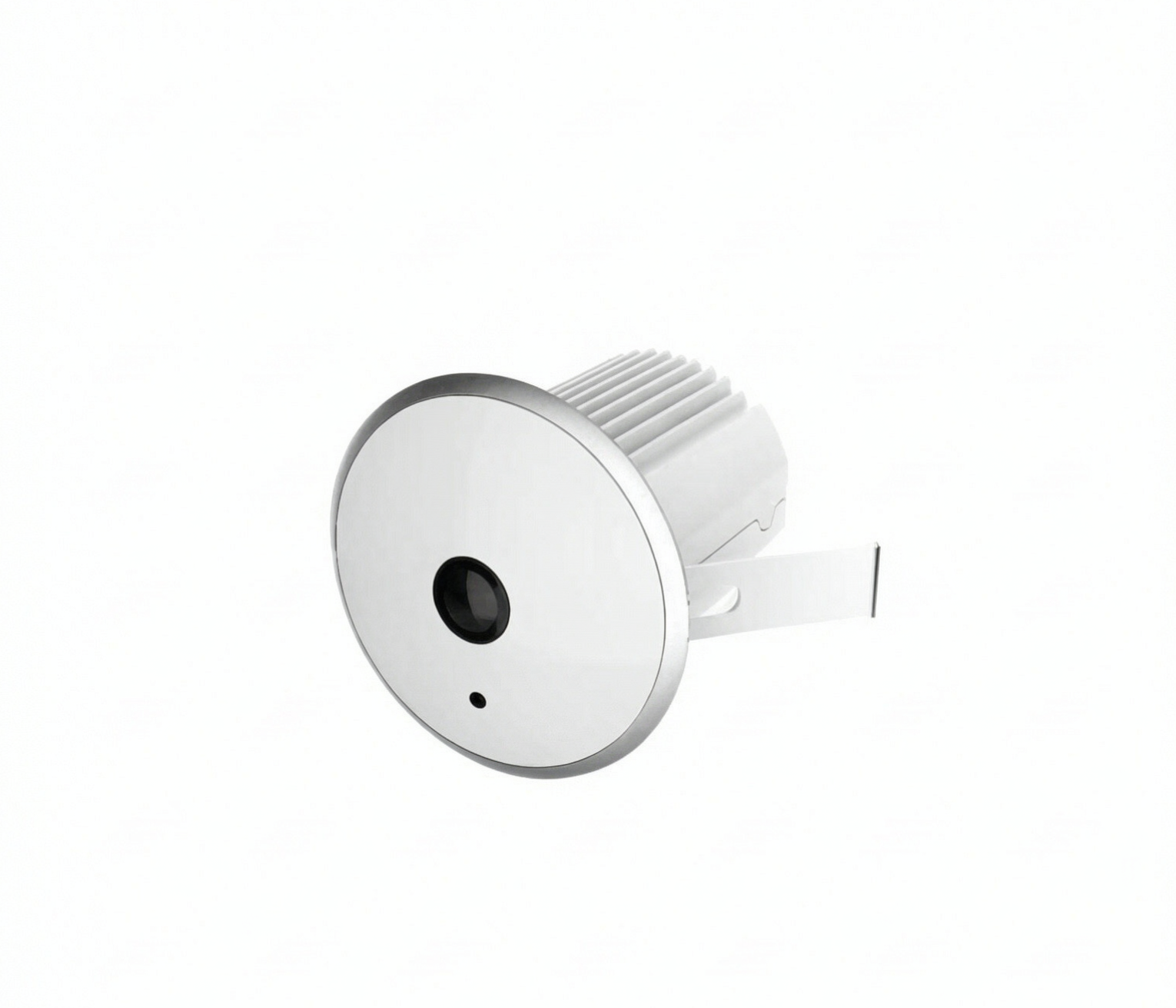
A quotation for one supermarket entrance lists four devices, all called a "people counting camera," at prices that span roughly a factor of three. Nothing explains why one costs more, or which will still be accurate when the sliding doors stand open all afternoon and a family of five walks in at once.
The device is the part of a deployment you mount, cable, calibrate, and live with for years. Category differences surface as undercounts on busy Saturdays and as support tickets in month six. This guide covers the device types you will be quoted and the conditions that decide which one fits.
What a "store traffic counter device" actually includes
A traffic counter is not only a sensor. In any usable deployment there are three parts:
- Sensing device — the unit mounted at the entrance, in the ceiling, or on a pole. This is what the quote prices.
- Processing — the logic that converts raw signal into counts and anonymous tracks. On most modern devices this runs on the unit itself (edge processing); older designs ship data to a local server or a cloud platform.
- Reporting and integration — the dashboard, CSV export, or API that a human or a POS system actually reads.
Buyers routinely compare only the first part, then discover the "cheap" device needs a paid subscription to produce an hourly report, or the "expensive" one already includes local buffering during outages. Compare complete systems, not boxes.
The device categories you will be quoted
Infrared beam counters
A pair of infrared beams sits across the doorway. Breaking the beam registers a pass, and the order in which beams break determines direction. Cost is low, installation is fast, and no image is captured at all.
The physical limit is the problem: a beam cannot separate two people walking through side by side, so a double-width entrance undercounts systematically. Anyone who stops in the doorway, a delivery trolley, or a queue spilling back through the opening creates false events. For a narrow single-file door in a small shop, a beam counter is a defensible choice. For a mall storefront with a three-meter opening, it will quietly understate traffic every busy hour of the day.
Overhead 2D AI cameras
The workhorse category. A camera mounted above the entrance runs a computer-vision model that detects people and tracks them across frames, counting each person once as they cross a virtual line.
Strengths: one device covers a wide opening, it can run on the same network and cabling as existing CCTV, and it produces more than a count — tracks support zone-level reporting inside the store, showing where people actually go. Staff can usually be filtered out of the counts in configuration.
Weaknesses: the model infers position from a single flat image, so accuracy degrades in dense crowds, heavy occlusion, and awkward light. A person carrying a large carton, a child walking beside a parent, or a reflective floor can all confuse a 2D model in ways a depth-based device would not.
3D stereo and depth devices
Two lenses at a fixed separation capture the same scene, and the device computes distance from the difference between the two images. The result is a depth map, not just a picture, and depth is what makes counting stable when people are packed together — two people standing shoulder to shoulder occupy different depth positions.
Strengths: reliable counting in dense traffic, more stable tracking through a crowd, and less ambiguity when a person is partially hidden. This is the category that earns its price at a busy mall entrance or a wide airport-style doorway. Weaknesses: more compute, more careful calibration, and a higher unit cost. Depth sensing also has a working range; mount it beyond that range and behavior degrades toward a plain 2D system, so device specification and mounting height must be matched deliberately.
Thermal and panoramic devices
Thermal sensing detects body heat rather than visible light, so darkness, glare, and strong backlighting stop being problems. Identity detail is inherently low, which is helpful in privacy-sensitive sites.
Fisheye panoramic devices take the opposite approach: a wide-angle lens covers a large area — an entire aisle, a food court, a lobby — from a single ceiling point. They are the practical way to get coverage data and zone heat maps rather than a door count, and they reduce the number of devices needed in an open space.
Both still have limits. Thermal devices struggle when a large group enters at once through a wide opening, and panoramic layouts need careful mapping so a track is not double-counted when it reappears in an overlapping view.
WiFi and Bluetooth probes
Instead of watching the door, the device listens to the wireless network, logging phones whose radios broadcast and estimating footfall and dwell from when those signals appear and disappear. Coverage is broad, installation is non-optical and often trivial, and the data can include repeat-visit patterns that no camera sees.
The caveats are serious: device randomization, people who carry no phone, and one person carrying two devices all distort the numbers. Treat probe data as a trend signal, not an official entrance count.
Off-grid 4G solar devices
For gates, construction sites, outdoor retail, parking areas, and rural branches where there is no power and no cable path, a solar-powered camera with 4G connectivity is the only category that installs at all. The design trade-off is different from every other device here: power budget and signal quality dominate. A device that saves energy by sleeping is not continuously counting in the way a wired unit does, so the reporting rhythm — real-time versus periodic sync — has to be specified up front.
Comparing the categories side by side
| Device type | Typical fit | Main weakness | Install effort |
|---|---|---|---|
| Infrared beam | Narrow single-file doors, lowest budget | Cannot separate people side by side | Very low |
| 2D AI camera | Standard entrances, indoor aisles, existing CCTV | Degrades in dense crowds and poor light | Low to moderate |
| 3D stereo | Dense traffic, wide doorways, malls | Higher cost, calibration-sensitive | Moderate |
| Thermal | Dark or glare-heavy entrances | Group entry, low identity detail | Low |
| Fisheye panoramic | Open areas, coverage and heat maps | Mapping and overlap care required | Moderate |
| WiFi / BLE probe | Broad trend coverage, repeat visits | Biased sample, weak as an exact count | Very low |
| 4G solar off-grid | No power, no cable, outdoor sites | Power budget limits continuous operation | Moderate, site-dependent |
Five conditions that decide which device is right
Specifications are secondary to site conditions. These five questions eliminate more wrong choices than any datasheet comparison.
1. Entrance geometry
Measure the opening width and the mounting height available. A single-file door and a four-meter mall frontage are different engineering problems, and the answer is not simply "a better camera" — it may be two devices covering one opening, or a different mounting plane.
2. Ceiling, mounting plane, and installation angle
Ceiling height determines whether a device can look straight down (which minimizes occlusion) or has to view at an angle (which increases it). Ask for the vendor's assumed mounting height and angle before you compare accuracy claims.
3. Lighting and environment
Glass doors with strong afternoon sun, mirrored surfaces, and light that changes with the hour all affect performance. In Southeast Asia, add humidity, dust, monsoon rain, and heat. Ask what protection rating the device carries and whether it is rated for outdoor or semi-outdoor placement. An indoor device mounted under a walkway canopy is a warranty argument waiting to happen.
4. Traffic density and pattern
A boutique with light traffic and a supermarket entrance at 18:00 are not the same measurement task. Density is the single strongest argument for depth sensing. Also check the pattern: does the entrance have a cross-traffic corridor beside it where people pass without entering? That risk of counting passers-by as visitors is solved by device placement and by defining the counting line carefully, not by buying a more expensive model.
5. Power, network, and output requirements
Confirm power availability (PoE is the usual answer indoor; solar plus 4G outdoors), whether local buffering exists for outages, and — most often overlooked — what the device can output. If your POS or BI platform needs an API or scheduled export, a device that only renders a vendor dashboard is not a fit, however accurate it is.
How to run a selection you will not regret
- Write down the question first. "How many people entered, by hour, for every day of the week" is a specification. "Some analytics" is not, and it will not let you judge devices.
- Shortlist by site condition, not by brochure. Use the five conditions above to eliminate categories before you compare models.
- Ask each vendor what they assume about your site. A vendor who does not ask about ceiling height, door width, and lighting is quoting a product, not a solution.
- Request sample output. Ask for an anonymized sample report or export in the format you would actually receive. This reveals more about usability than a feature list.
- Pilot on one entrance and verify. Count by hand for a session at a busy hour, compare with the device, and repeat on a different day. Keep this acceptance test as your standard for rollout.
- Then scale with one configuration. Chains that standardize mounting height, angle, and counting-line rules across stores can compare them; those that let every site differ cannot.
Red flags in a counting device quotation
- An accuracy figure quoted without stating the conditions it was measured under.
- No questions about your site, entrance layout, or existing network.
- A reporting dashboard that requires a recurring subscription, with no local export or API.
- No local storage or buffering, so an internet outage is also a data outage.
- Ambiguity about who installs, calibrates, and supports the device after handover.
None of these are automatic disqualifiers, but each should be answered in writing before you sign a purchase order.
FAQ
What is the difference between a traffic counter device and a people counting system? The device is the sensor unit; the system is the device plus processing plus the reporting layer you use. Two quotes can contain the same sensor category and still deliver very different systems, depending on processing, buffering, and integration.
Do I need a camera, or will a beam counter do? If your entrance is narrow, single-file, and traffic is light, a beam counter can be enough and costs far less. If the opening is wide, or two people can walk through together, beams will undercount and a camera-based device is the realistic option.
Can one device cover two entrances? Sometimes, if both openings sit inside one field of view and the analytics supports separate counting lines. The reliable test is a pilot — coverage claims on paper often assume ideal mounting that the real site does not provide.
How long does installation take? For an indoor entrance with existing network cabling, mounting and calibration is typically a short session per device. Off-grid or outdoor sites, retrofit cabling, and multi-zone layouts add planning time. The variable that most affects the schedule is whether the mounting position and network path already exist.
---
To see how these categories map to retail, mall, and public-building deployments, review the solutions overview, and browse the product center for the camera families HooViz builds for entrance counting, in-store coverage, and off-grid sites. If you have a floor plan or an entrance survey to work from, send it to our team and we will tell you which category fits — including when a device we do not sell would serve you better.