
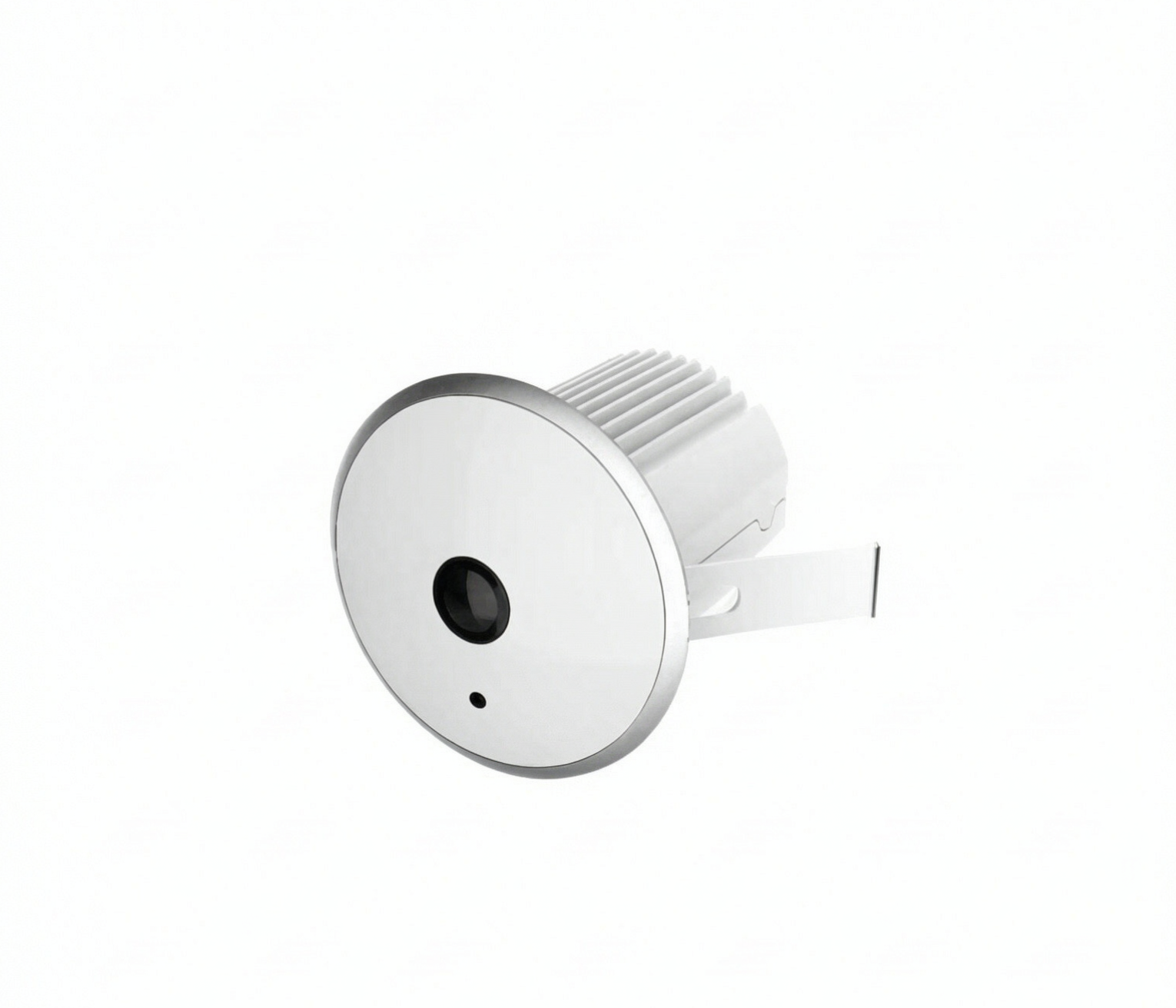
A glass shopfront on a busy street is one of the hardest places to count people reliably. At midday the doorway blows out to white as sunlight hits the glass; after dark the same door becomes a black rectangle against a lit interior. Visible-light analytics that performs well over an interior aisle can lose entries and invent them at precisely the hours when the numbers matter most. Thermal sensing is the usual answer to that class of problem — and it brings its own set of limits that are worth understanding before you write it into a specification.
This article explains how thermal sensing produces counts, the conditions where it clearly outperforms visible-light AI, the conditions where it does not, and how to decide between thermal, visible-light, and a camera that carries both.
How thermal sensing produces a count
What the sensor actually responds to
A thermal sensor does not measure reflected light, it measures emitted heat. Each pixel reports the temperature of whatever the lens is pointed at, and the image it produces is a temperature map rather than a photograph. A person is usually warmer than the floor, the wall and the shelving behind them, so a person appears as a distinct warm blob against a cooler background.
That single difference explains most of the technology's behaviour. Because no illumination is required, thermal counting does not care whether the site is in daylight, under sodium street lighting, or in complete darkness. Because the signal is temperature rather than brightness, a spotlit doorway or a reflective glass facade does not confuse it in the way it confuses a visible-light sensor.
What thermal sensing does not give you is detail. There is no colour, no texture, no readable sign, and no usable face image. The information it carries is closer to "a person-shaped warm region moved in this direction" than to video.
From heat map to counts
Counting itself is a software problem layered on top of that signal. A typical pipeline detects warm blobs, filters out steady heat sources such as radiators, lamps and equipment, tracks each blob across frames, and applies a line-crossing or region rule to decide whether an event counts as an entry, an exit, or a presence in a zone. The counting logic is broadly the same family of algorithms used behind visible-light systems; what changes is the input, and therefore where the errors appear.
This matters when you compare vendors. Two systems can have similar counting accuracy in a well-lit test corridor and diverge badly at a real entrance, because the deciding factor is how the detector handles the specific failure mode of the site — heavy backlight for one, low temperature contrast for the other.
Where thermal wins
Total darkness and night entrances
Any site whose traffic matters outside daylight hours is a candidate. Night-time entries at a hotel side door, a warehouse shift change at dawn, a car park stairwell with intermittent lighting, an industrial gate after hours. Visible-light systems can handle these with infrared illumination, and often do, but infrared illuminators have range and reflection limits, and a person hurrying past at distance may not receive enough light.
Glare, backlight and glass
This is the strongest argument for thermal in retail. A south-facing entrance, a mall doorway that opens onto a bright atrium, a convenience store with glazing on two sides — all create the contrast problem that visible-light sensors are worst at. Thermal is largely indifferent to visible light, so the same door it sees at noon it sees at midnight. If your main entrance data is currently unreliable and the entrance is glass, backlit, or sunlit, thermal is a rational first thing to test.
Dust, smoke and harsh environments
Thermal also tolerates conditions that degrade image quality: dusty yards, sites near production, kitchens and loading areas, and environments with vapour or fine particles in the air. It does not see through walls or opaque obstacles, but it is less dependent on clean air and clean glass than a camera whose whole signal is light.
Warehouses and cold stores are another favourable case. Ambient temperature stays well below body temperature through the whole shift, so the contrast between a person and the background is high and stable, while visible-light cameras in the same space contend with condensation, frost, and the fog that rolls out when a door opens. The reverse — a hot plant room where ambient temperature climbs toward body temperature — is where thermal loses that advantage.
Privacy-sensitive deployments
Thermal sensing is often chosen for anonymised traffic analytics because it does not produce an identifiable image in the ordinary sense. That is a genuine advantage at entrances where customers would object to a normal camera, and in jurisdictions where image-based analytics attract scrutiny. Important caveat: thermal is not an automatic legal exemption. Whether a deployment is lawful depends on notice, purpose, retention, storage location, and the applicable rules in the market — matters that should be confirmed with a qualified legal adviser rather than assumed from the sensor type. Thermal also does not stop a thermal and visible-light dual-sensor unit from recording images, so check what the unit actually stores.
Where thermal struggles
Low contrast on warm days
When ambient temperature climbs close to body temperature, the warm blob a person produces gets fainter. An outdoor entrance on a hot afternoon in Southeast Asia is a less favourable environment than the same entrance on a cool morning. Clothing matters too: a person in a long coat against a warm wall presents less contrast than a person in a t-shirt against a cold street. Sizing a thermal deployment for a tropical outdoor site needs local testing at the worst hour, not a bench demonstration.
Dense crowds and cross-talk
Counting a stream of individual people past a door line is a different problem from counting a dense, slow-moving crowd. In a packed aisle or a queue, adjacent bodies merge into one warm mass, and separating them becomes inference rather than detection. Visible-light systems struggle here too, but a good 3D stereo system often holds up better in dense traffic because it measures depth as well as appearance. Expect thermal accuracy to degrade as density rises, and plan for that if the site has peak-hour crush.
Glass blocks the signal
Thermal energy does not pass through ordinary glass. A camera aimed through a window will read the window, not the street behind it. That is usually fine for an entrance-facing mount, but it rules out putting a thermal unit behind internal glazing, and it means glass doors and partitions can block the view of the area you wanted to cover. Poorly insulated or reflective surfaces can also add confusing temperature structure to the scene.
No video evidence and no identity
Thermal cannot give you a face, a vehicle plate, a uniform colour, or a usable clip for an incident report. Sites that need both traffic analytics and evidentiary video normally need a dual-sensor design or a paired visible-light camera, and that affects device count, cabling and platform integration.
Cost relative to visible-light cameras
Thermal modules cost more than comparable visible-light modules, which makes thermal the more expensive per-device option for a site where lighting conditions are already good. On a fully lit interior, a visible-light AI camera will usually deliver the required counting at a lower unit cost, and the engineering effort is better spent on mounting and calibration.
Choosing between thermal, visible-light, and both
Use these rules as a starting point.
- Choose thermal when the site is dark for a meaningful share of trading hours, the entrance faces bright sun or heavy glass glare, the environment is dusty or vapour-heavy, or the site requires counting without identifiable imagery.
- Choose visible-light AI when lighting is controlled and adequate, you also want video evidence, you need zone-level detail such as shelf interaction or queue behaviour, or unit cost per door is the binding constraint.
- Choose dual-sensor or a paired camera when you need the traffic reliability of thermal plus video for security and operations. The extra cost is generally justified where one system has to serve both analytics and incident review.
Selection criteria that decide the outcome
Before specifying, get answers to these from the site: the ambient temperature range through the year and through the trading day; whether the counting point is indoor, sheltered outdoor, or fully exposed; expected people per minute at peak and typical density at the door line; door width and the standing distance available for a mount; whether the site also needs video evidence; and whether power and network are available at the mount point. Then test at the real mount height with real traffic at the busiest and worst-lit hour. A short side-by-side trial — thermal and visible-light counting the same door for a week — is usually the cheapest way to settle the question, and it produces the per-hour error pattern that no specification sheet can give you.
Mounting discipline matters as much for thermal as for any counting camera. Height, angle, and the exclusion of hot equipment from the field of view determine whether the detector sees people rather than radiators and lamps. Steady heat sources near a door — a heater, a hot display case, a compressor — should be excluded with masking during commissioning, not left for the analytics to reject on its own.
FAQ
Does a thermal camera work in complete darkness? Yes. Thermal sensing depends on emitted heat rather than illumination, so it counts without any visible light. That is the main reason it is used at night entrances and unlit yards.
Can thermal counting see through walls or glass? No. Thermal energy does not pass through ordinary building materials or glass, so a camera behind a window reads the window instead of the scene beyond it. Mount where the sensor has direct line of sight to the counting area.
Is thermal people counting more accurate than visible-light AI? Not in general. It is more reliable in darkness and against glare and backlight, and less reliable where ambient temperature is close to body temperature or where crowds merge together. The right choice depends on the site's failure modes, which is why an on-site trial matters more than a headline accuracy figure.
Does thermal counting avoid privacy obligations? It reduces the amount of identifiable information collected, which is a real advantage, but it does not remove the need for notice, a defined purpose, limited retention, and compliance with the applicable rules in each market. Confirm the specifics with a qualified legal adviser for each country you deploy in.
Can I add thermal counting to an existing video system? Often yes, if the recording and analytics platform accepts an additional stream or integrates at the API level. Dual-sensor units and separate thermal devices both work; the practical question is whether your platform can ingest and store the thermal stream alongside existing video.
---
If you are working through a difficult entrance — glazed, backlit, dark for half the day, or in a dusty yard — the product centre lists the camera families built for overhead and panoramic coverage, and the solutions overview shows how counting, zone analytics, and thermal options combine in retail and industrial deployments. Send the site conditions and floor plan through the contact page and we will help you narrow the choice before you commit hardware.