
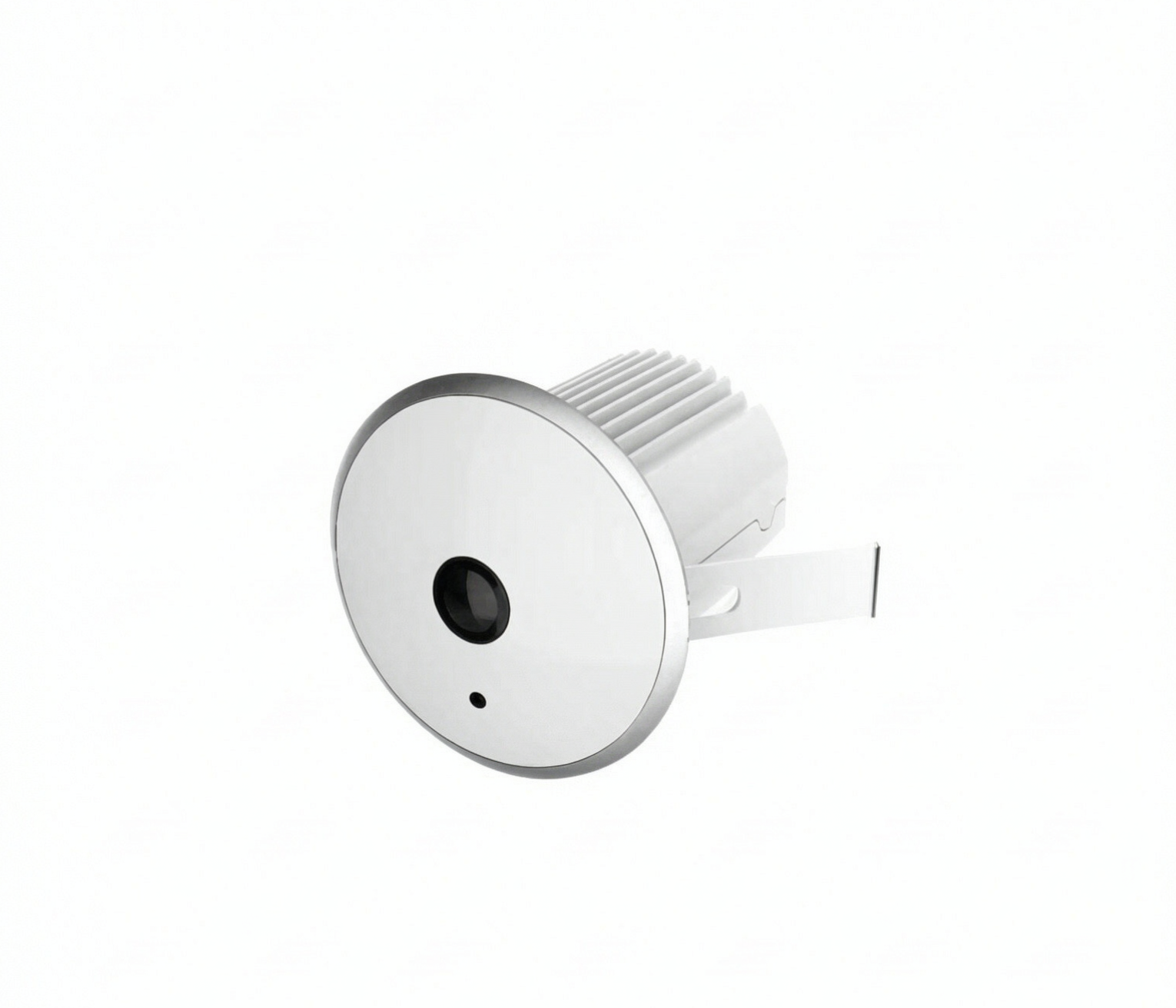
Choosing a people counting camera is not a matter of picking the most accurate model. It is a matter of matching the sensing technology to the physical reality of the site — entrance width, ceiling height, crowd density, power availability, network availability, and what the customer will do with the data afterwards.
This page walks through the five HooViz product families, the conditions each is built for, and how to decide between them.
Start with the site, not the model
Before looking at a catalogue, answer these questions about the installation:
- How wide is the entrance? A single 900 mm door and a six-metre mall storefront are different engineering problems.
- How high is the mounting position? Ceiling height determines the viewing geometry and whether a top-down count is possible.
- How dense does traffic get? A boutique with gaps between customers and a supermarket entrance during a promotion are not the same counting environment.
- Indoor, outdoor, or covered semi-outdoor? Direct sunlight, rain, and temperature range narrow the options quickly.
- Is there mains power at the mounting point? If not, the design changes before anything else is discussed.
- Is there a reliable network connection? Edge processing and local buffering decide whether a dropped link costs you an hour of data or nothing.
- Is the count needed at the door only, or inside the store as well? Door counting and zone analytics use different mounting positions.
- What does the buyer do with the output? Live occupancy control, historical chain reporting, and integration into an existing VMS or BI platform imply different requirements.
- What quantity is involved? A single store project and a two-hundred-store rollout have different unit economics, and that affects which family makes sense.
- Are there privacy constraints? Some buyers prefer sensing that does not depend on identifiable imagery.
A project spec built from these ten answers essentially selects the model by itself.
The five camera families
3D binocular high-precision passenger flow camera
Two lenses with a fixed baseline capture the same scene from slightly different angles, and depth is computed from the disparity between the images. Counting decisions are made on that depth information rather than on a flat picture.
Where it fits: wide entrances, high-density traffic, double-height lobbies, and sites where two people walking shoulder-to-shoulder must be separated reliably. Also useful where the entrance has glass on both sides or where a flat 2D view would be ambiguous.
Where it does not: very small single doors, where a simpler sensor is sufficient and cheaper, and installations with an impractical mounting height for the product's working geometry.
Typical projects: shopping mall main entrances, transport terminals, large-format retail, stadium and event venues, public building access points.
Fisheye panoramic thermal camera
A wide-angle fisheye view covers a large area from a single ceiling position, which makes it the natural choice when the customer wants zone-level insight rather than a single door count. The thermal sensing element gives it a second source of information beyond visible light.
Where it fits: store interiors where you need to see which zones attract attention and how long people stay, not just how many walked in. Also useful for environments where visible-light detection is difficult, and for buyers who want counting that does not depend solely on identifiable imagery.
Where it does not: door-line counting accuracy in very dense crowds, which remains the strength of the 3D stereo approach.
Typical projects: retail stores and malls running zone heatmaps and dwell analysis, exhibition spaces, large indoor public areas.
Note that any thermal or heat-signature based approach has physical limits — very warm ambient conditions and heavy clothing reduce the signal. Confirm the expected conditions with the supplier before committing to thermal for an outdoor or tropical semi-outdoor site.
4G solar-powered off-grid camera
A camera with its own power source and its own cellular connection, for sites where neither mains electricity nor a data cable exists or where running either is impractical.
Where it fits: construction sites, temporary installations, isolated car parks, agricultural and industrial sites, perimeter monitoring, and locations where a subscription-free link is a requirement. It is also a practical answer for sites where trenching and cabling cost more than the hardware.
Where it does not: high-density indoor counting, where mains power and a stable network are normally available and a dedicated counting camera is the better instrument.
Typical projects: off-grid surveillance, remote site monitoring, and any deployment where the site is not yet connected.
Because solar generation depends on sunlight hours and battery capacity on load, the sizing conversation matters: how many minutes of video, how many events per day, and how much of the year the site sees reduced sunlight. Ask for the power budget assumptions in writing.
2D AI economy passenger flow camera
A conventional form-factor camera paired with a computer-vision model that detects and tracks people, counting each individual once as they cross a defined line at the entrance.
Where it fits: standard single and double door entrances, ordinary retail traffic density, and projects where budget discipline matters. It runs on the same cabling, power, and network approach as conventional CCTV, which simplifies installation on existing sites.
Where it does not: extreme crowd density or scenes with heavy occlusion, where depth sensing performs more consistently.
Typical projects: individual retail stores, small chains, clinics, banks, restaurants, gyms, and building entrances with normal traffic levels.
AI NVR
The aggregation layer. When a site has several cameras — counting, general surveillance, or both — an NVR with analytics capability keeps recording and analytics local, and gives a single point from which data is forwarded to a reporting platform.
Where it fits: multi-camera sites where the customer wants local recording and local analytics rather than sending everything to the cloud, or where connectivity to a central platform is intermittent and local retention is required.
Where it does not: a single-door store with one camera, where it usually adds cost without adding function.
Typical projects: malls, mixed-use buildings, factories, campus sites, and chains that standardise on local aggregation per site.
Matching table
| Condition | Recommended family |
|---|---|
| Wide, high-traffic entrance; dense crowds | 3D binocular passenger flow camera |
| Zone heatmaps, dwell time, interior analytics | Fisheye panoramic thermal camera |
| No mains power, no network, or both | 4G solar-powered off-grid camera |
| Standard doors, normal density, budget-controlled | 2D AI economy passenger flow camera |
| Multiple cameras per site needing local retention | AI NVR |
| Off-grid outdoor site that also needs counting | 4G solar camera, with the counting zone defined at design stage |
| Mall entrance needing both traffic and interior zones | 3D binocular at the entrance, fisheye thermal inside |
How the families combine
Real projects rarely use one line in isolation. Three common patterns:
- Chain retail. 2D AI economy cameras at standard store entrances, with 3D binocular at flagship stores where entrances are wide and traffic is dense, and an AI NVR at larger formats.
- Shopping mall. 3D binocular at main entrances and corridors, fisheye thermal inside tenant zones, NVR aggregation per building, with traffic reported per entrance and per mall level.
- Off-grid and infrastructure. 4G solar cameras on sites without power or connectivity, forwarding counts and events when a link is available.
Deciding the combination at design stage, rather than adding cameras store by store, is what keeps the data comparable across a chain.
What to send us for a quote
A quote that fits your project requires a handful of specifics:
- Number of sites, and entrances per site.
- Entrance width and mounting height for each type.
- Indoor, outdoor, or covered; approximate sunlight and weather exposure for outdoor sites.
- Expected peak traffic, even a rough estimate.
- Power and network availability at each mounting point.
- What data is needed: door counts only, or zone and dwell analytics as well.
- Whether the output must feed an existing platform, and in what format.
- Branding requirements, if an OEM/ODM relationship is intended.
- Quantity and delivery expectations.
With those, a recommendation takes one conversation instead of three.
Buying route
Three routes are available depending on your organisation:
- Direct with HooViz for integrators and end customers specifying a project.
- Through a local distributor where one is appointed in your country, which usually means faster delivery and local warranty handling.
- OEM/ODM for partners who want their own brand, housing configuration, or firmware packaging, subject to minimum volume requirements that depend on the customisation.
All three routes use the same underlying hardware and analytics; the difference is commercial, not technical.
FAQ
Which model is the most accurate? Accuracy depends on the match between technology and site, not on a ranking of models. A 3D binocular camera is the better instrument at a crowded wide entrance; a 2D AI camera is entirely adequate at a standard door with normal traffic. The right question is which technology fits your geometry and density.
Can one camera count traffic and produce heatmaps? Some installations cover a wide interior area with a fisheye camera that supports both counting and zone analytics, but door-line accuracy and interior coverage are different mounting objectives. Where both matter, separate devices at separate positions is usually the cleaner design.
Does HooViz hardware work with third-party VMS or BI platforms? Integration depends on the specific platform and the interface your project requires. Raise the requirement at specification stage with the target platform named, so compatibility can be confirmed before the order rather than after installation.
Is an NVR required, or can cameras report directly? Cameras can forward their own counts and events where connectivity is reliable. An NVR makes sense when a site has multiple cameras, when local recording must be retained, or when the site link is intermittent — in those cases it becomes the local aggregation point.
What is the minimum order for OEM/ODM branding? It depends on the level of customisation: a label and packaging change is a different matter from a custom housing or firmware modification. Tell us what you want to change and we will confirm the requirement for that configuration.
---
HooViz builds all five families described here and supplies integrators, distributors, and OEM/ODM partners across Southeast Asia and beyond. The product center lists the current models and their intended applications, and the solutions section shows how they are deployed by industry. If you send your entrance dimensions, site conditions, and quantities, our team can recommend a configuration for your project — contact us here, and you can read more selection guides and deployment notes on the HooViz blog.