
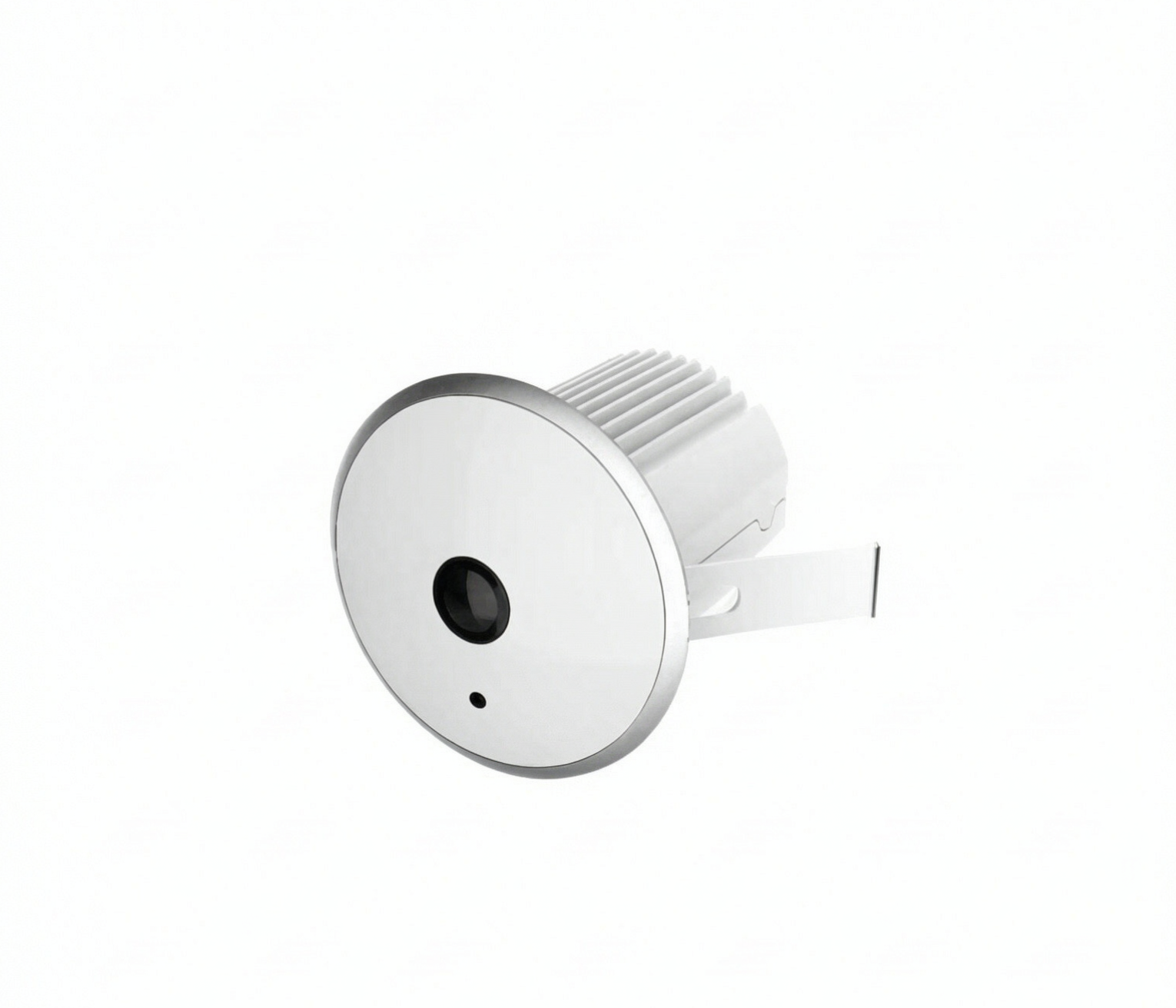
Two vendors pitch a shopping mall manager in the same week. One promises footfall for the entire building, three floors and every corridor, from four small boxes that need no cabling to the shopfronts. The other promises accurate entrance counts with dwell and zone data, but needs a camera above every store door. Both are telling the truth about their own technology. They are simply measuring different things.
WiFi probe counting and camera-based counting are frequently compared as competing ways to produce the same number. They are not. Understanding what each one actually observes is the fastest route to a specification you can defend.
The two methods in one paragraph each
WiFi counting listens to the wireless environment. A sensor records the presence of client devices whose radios announce themselves, and estimates footfall and dwell from when those signals appear, persist, and vanish. It measures devices in radio range, and infers people from that.
Camera counting looks at the entrance. A model detects people in the image, tracks them across frames, and counts each one once as they cross a defined line, then follows them through zones where coverage allows. It measures people crossing a line, directly.
Every practical difference between the two methods follows from that distinction.
How WiFi probe counting works
Client devices periodically transmit management frames — probe requests while searching for known networks, and association traffic when connected — and each frame carries the device's MAC address and signal strength. A sensor that captures these frames can estimate how many distinct devices are present and how long each stays in range.
Three properties of modern phones weaken the method:
- MAC randomization. Apple introduced randomized addresses for scanning in iOS 8 and per-network randomization from iOS 14; Android added scan randomization in version 6 and per-network randomization in later releases. A randomized address still appears in the data, but it no longer identifies the same phone across sessions, so repeat-visit measurement degrades badly.
- Not every person carries an active radio. Children, some older shoppers, people with WiFi disabled, and anyone who leaves a phone in a bag or a car are invisible to the sensor.
- One person, several devices. A phone and a smartwatch can appear as two devices, inflating counts.
The result is a sample that is directionally informative but structurally biased. It is excellent for relative trends across hours and days, and unreliable as an absolute entrance count.
How camera counting works
A camera-based counter runs detection and tracking on the device itself. Each person crossing the virtual counting line generates one event with a timestamp and direction. Where the camera also covers the store interior, the same track can be associated with zones, producing dwell time and heat maps rather than a single threshold number.
Because the sensor observes people directly rather than inferring them from radios, it does not care whether a shopper carries a phone, has WiFi enabled, or uses a recent operating system. Their error modes are physical instead: occlusion in dense crowds, difficult lighting, mounting angle, and the group problem, where several people enter together and are counted individually but buy as one transaction. That last point matters when you compute conversion, because a group purchase lands as one transaction against several entries.
Head to head
| Dimension | WiFi probe | Camera |
|---|---|---|
| What is measured | Devices in radio range | People crossing a defined line |
| Coverage per unit | Broad, tens of meters, through walls | Narrow, the field of view only |
| Absolute entrance count | Biased sample, not authoritative | Direct count, with a stated error mode |
| Dwell time | Estimated from signal presence | Measured from tracked path |
| Zone and path data | Very coarse | Detailed, per zone |
| Repeat visits | Degraded by MAC randomization | Track-based within a session only |
| Cabling needs | Minimal, often PoE or USB power | PoE or network path to each entrance |
| Privacy exposure | MAC addresses can be personal data in some jurisdictions | Images processed for detection, retention configurable |
| Cost structure | Lower hardware, broad coverage | Higher hardware, but produces the richer dataset |
| Main failure mode | Crowd bias, unrepresentative sample | Occlusion, lighting, mounting |
Where WiFi genuinely wins
It is not the weaker method everywhere. There are three situations where it is the better engineering choice.
Whole-building coverage without cabling every door. A mall corridor, a food court, or a large public concourse is expensive to instrument with cameras. A handful of radio sensors can report relative traffic and dwell across the whole space at a fraction of the installation cost — useful for comparing zones and spotting trends, provided nobody treats the output as a headcount.
Areas where cameras are unacceptable. Some tenants, leased spaces, and public facilities have policies that rule out optical recording entirely. Radio sensing avoids that confrontation. Even then, note that a MAC address has been treated as personal data by European data protection authorities, so consent and notice questions remain. Any deployment like this should be reviewed by legal counsel in your jurisdiction before launch.
Repeat-visit patterns, in the specific case where randomization is not the dominant factor. With a properly configured guest network and consenting users, association data can reveal returning customers over time. On open public WiFi sensing, this collapses; on a controlled captive-portal network, it can hold up.
Where camera counting is the only honest answer
If you need any of the following, radio sensing cannot deliver it, and a proposal claiming otherwise should be challenged:
- A conversion-rate denominator. Conversion is transactions divided by people who entered. If the denominator is a biased device sample, the conversion figure inherits that bias and cannot be compared across stores with different device mixes.
- Zone-level merchandising insight. Which displays get seen, which aisles get skipped, where people stop. This requires seeing inside the store.
- Queue and service analytics. Wait time and queue length depend on knowing how many people are standing in a specific area, not how many radios are nearby.
- Staff exclusion. A camera-based system can identify and remove staff from customer counts. A radio system counts staff phones like anyone else's.
- Defensible numbers in a lease or audit conversation. Mall tenants, franchise benchmarks, and performance contracts usually require an agreed, testable counting method. "The trend from probes" is not that method.
Where accuracy claims get inflated
Two claims deserve scrutiny from any integrator.
For WiFi, the claim to test is representativeness. Ask what share of your actual visitors the sample covers, and how the vendor handles that share varying by time of day, tenant, and building. Most vendors cannot answer this, because the answer is site-specific.
For cameras, the claim to test is error under your conditions. A counting error measured on a low ceiling with light traffic does not transfer to a wide glass entrance at 18:00. Ask for the mounting assumptions behind any figure, then verify on site with a manual count. Our guide on choosing a store traffic counter device walks through the acceptance test in detail.
How to decide
Work through this list in order; it usually settles the question in a few minutes.
- What decision will the number drive? Staffing and conversion analysis need a real entrance count. Broad space planning can tolerate a trend series.
- Do you need interior zone data? If yes, only camera-based sensing is in scope.
- What does the site allow? Radio-only sites exist. Check them early rather than after designing a camera layout.
- What is the cabling reality? Count the doors that need coverage and price the network work honestly, not just the hardware.
- What is the accuracy floor? If the number will be used in a contract, benchmark, or audit, specify an accepted verification method and require it in writing.
- Consider the hybrid. Camera counting at customer entrances for authoritative counts, plus radio sensing for broad coverage where cameras cannot go. Report them separately rather than blending them into one "footfall" figure — blending two differently biased sources produces a number that is precise-looking and uninterpretable.
FAQ
Can WiFi counting replace a people counting camera at the door? For trend tracking across hours and days in a single location, it can be adequate. For an absolute count, a conversion denominator, or anything contractual, it cannot. The sample is structurally biased in ways that vary by site, and no calibration removes that.
Does MAC randomization make WiFi counting useless? No, but it changes what the data can support. Randomized addresses still register as presence, so relative traffic and dwell trends remain usable. Persistent identification of the same person across visits generally does not.
Which method is cheaper? Radio sensors usually cost less per unit and need less installation, especially for wide coverage. Camera-based systems cost more up front but produce the dataset most retail decisions require, so cost per usable insight often favors cameras for store-level work.
Do WiFi sensors collect personal data? Potentially. A MAC address has been treated as personal data by regulators in Europe, and device-derived location data is sensitive in several Southeast Asian frameworks. Sensor vendors sometimes describe their products as anonymous by default; whether that holds depends on configuration and jurisdiction. Treat it as a legal question and confirm with your counsel before deployment.
Can the two systems be used together? Yes, and this is often the most sensible design. Keep the camera count as the authoritative entrance figure and use radio data to describe areas cameras do not cover. Report each with its own method note so nobody downstream compares them as equivalents.
---
If you are specifying counting across several entrances or a mixed indoor and outdoor site, the product center lists the camera families HooViz builds for entrance counting, in-store coverage, and off-grid locations. If you have a site plan, send it through our contact page and we will say plainly which parts of it a camera can measure and which parts a radio sensor should handle.